Flare has one job: get two people who should meet into a conversation, then get out of the way. Here’s what happens on each phone, what happens on our service, and what nobody ever sees.
A guest’s evening
1 of 6
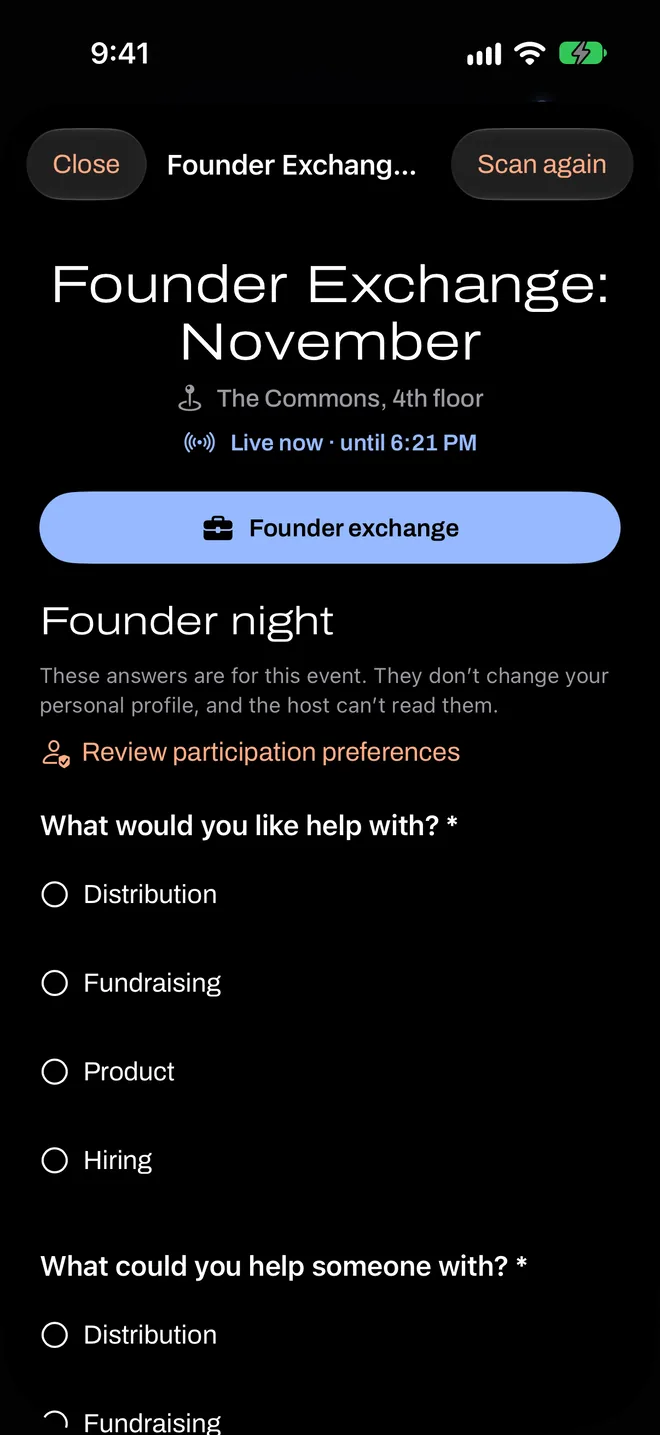
Scan and answer
A guest scans your live code and answers your questions. There’s no sign-up. A secure key on the phone stands in for an account.
2 of 6
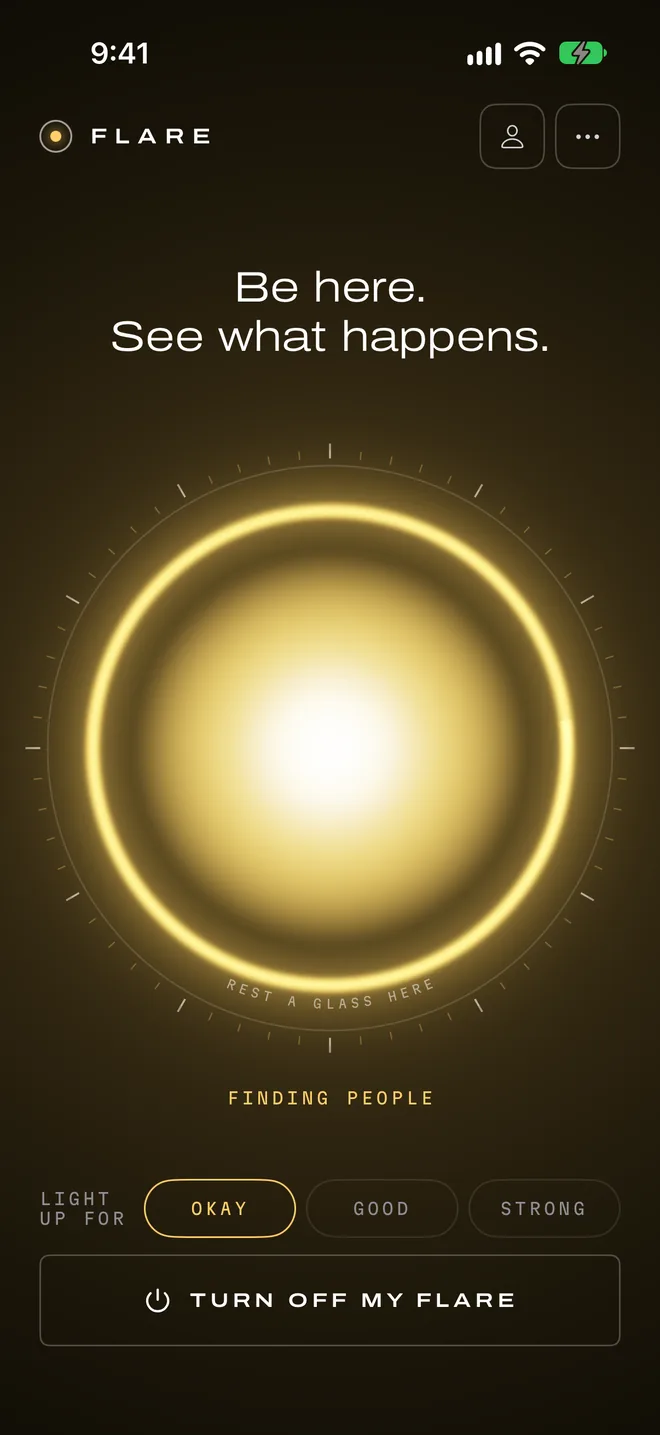
Light my flare
Their answers go to your event’s private room, and their light starts searching. They can put the phone away and wait for a buzz, and they can choose how good a match has to be.
3 of 6
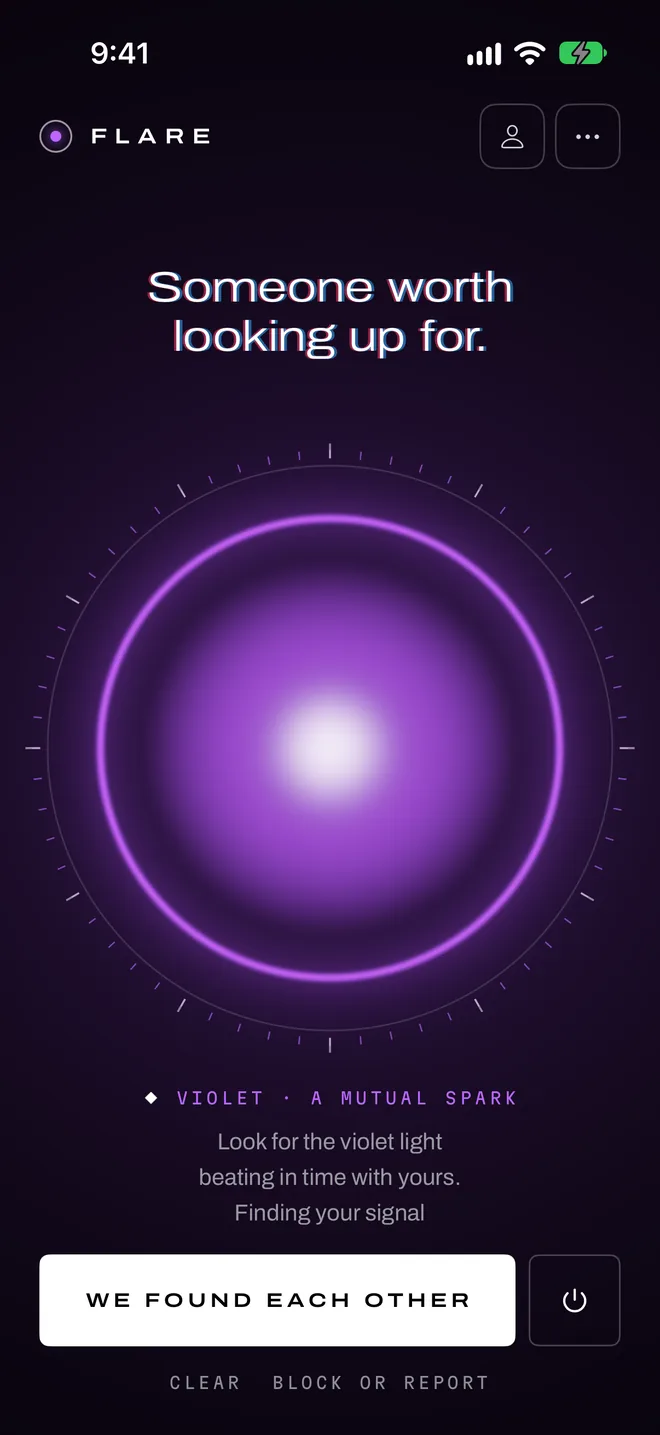
A shared light
When Flare finds a fit, both phones light in the same color and rhythm, in time with each other.
4 of 6
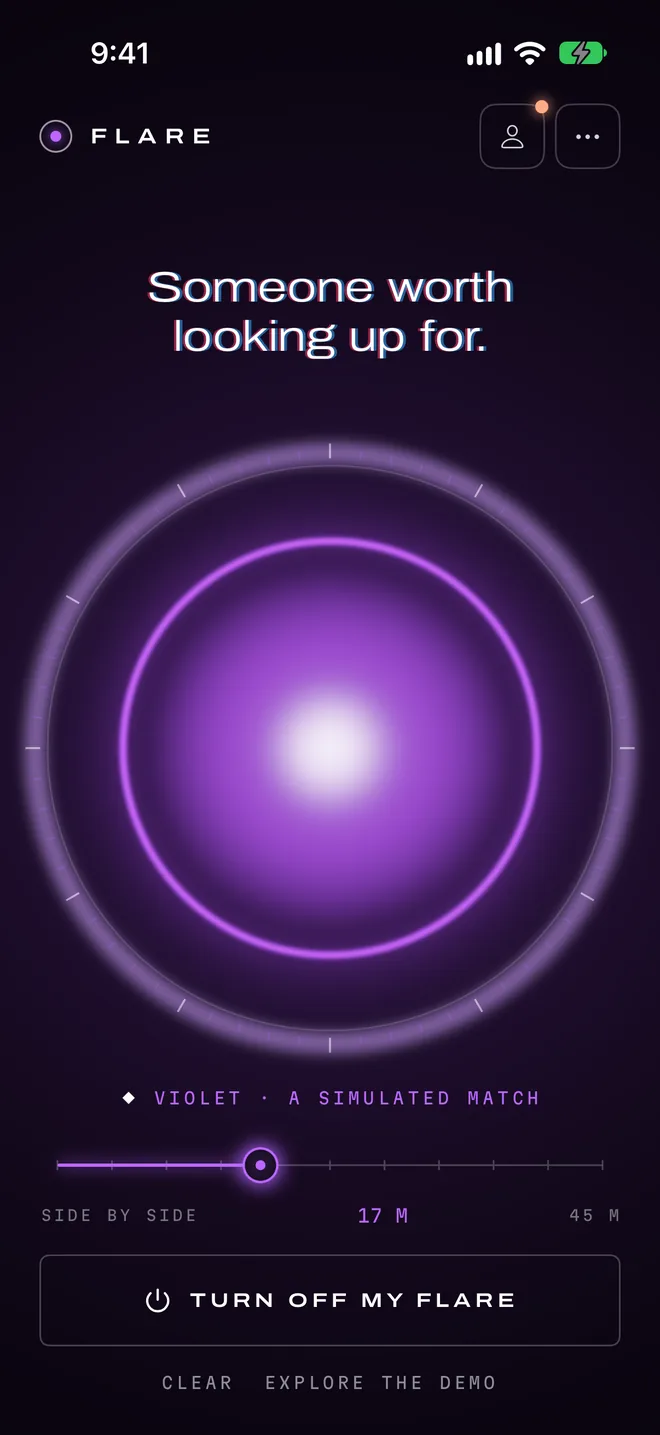
Closer, faster
The two phones sense each other. The pulse gets faster and brighter as they get closer. There’s no map or arrow, so people look up.
5 of 6
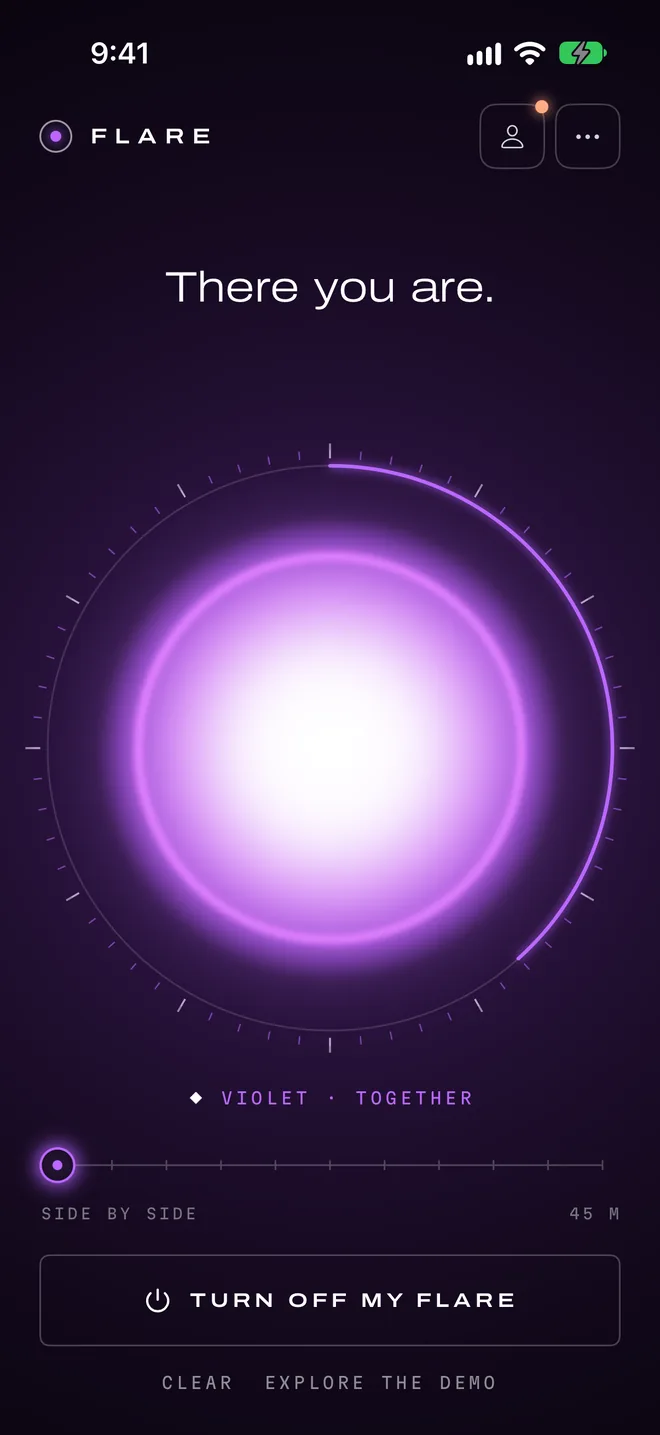
There you are
Side by side, the light holds steady. Ten seconds together or a tap on “We found each other” completes the introduction.
6 of 6
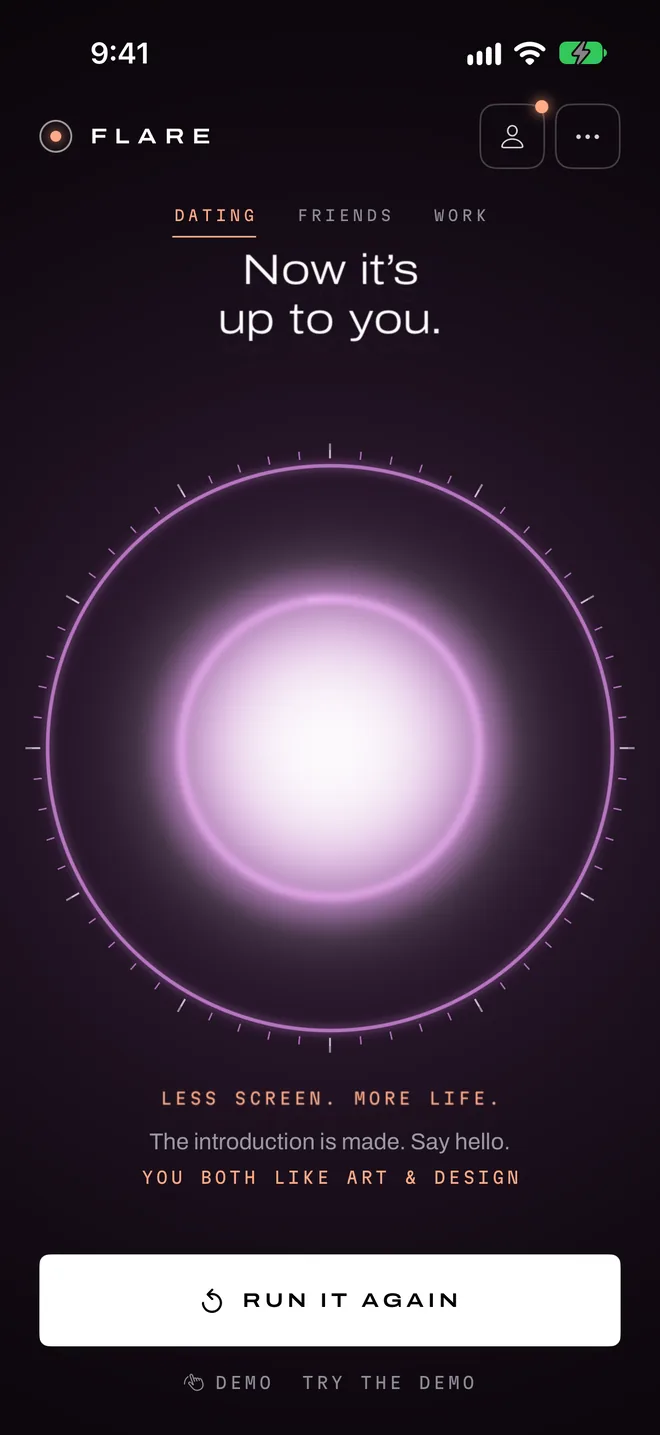
Now it’s up to you
The light goes out. They may see something they have in common. Phones go back in pockets, and the app’s job is done.
How Flare decides who meets.
Rules decide who can be introduced, and they’re enforced by code. The AI only ranks people who’ve already passed them. Nothing about ranking can override a preference, a dealbreaker or a block.
1
Everyone in the room
Each guest’s answers, in your event’s private room. People match only within the same context: dating, friends or work.
2
Rules that can’t bend
Code removes anyone who can’t be introduced: minors, people outside mutual preferences, dealbreakers, blocks and people who’ve already met.
3
A shortlist
Your questions are scored by code, using your rules and importance. Each person’s best 12 go forward.
4
AI ranks fit
Cloudflare’s Clef models rank those shortlists from answers alone, with placeholders in place of people. Names and IDs aren’t sent.
5
The best pairs
Flare picks the strongest pairs across the whole room, so nobody is offered to two people at once. Each pair has to reach the higher of the two guests’ match levels, and a final check can veto a clash.
6
Two lights
Each pair gets a signature nobody nearby has. Both phones pulse from the same clock, so they beat in time.
Each pair gets one of four colors and one of three rhythms. Flare uses every color once before repeating one with a different rhythm. In a busy room, two pairs might share a signature, but they’d be out of time with each other. You’re looking for the light that beats in time with yours.
Getting closer changes the speed, never the number of beats. The light never goes past three flashes a second. Each color has its own symbol as well, so it doesn’t depend on telling colors apart, and Reduce flashing softens the beats.
Violet, one beat
Violet, two beats
Violet, three beats
Rose, one beat
Rose, two beats
Rose, three beats
Lime, one beat
Lime, two beats
Lime, three beats
Ice, one beat
Ice, two beats
Ice, three beats
Closeness stays between two phones.
Once matched, the two phones find each other over Bluetooth and, on iPhones that have it, Ultra Wideband. Anything they exchange is encrypted with a key only they share. It’s worked out on the phones, and our server never sees a position or a distance.
Flare doesn’t use GPS. The light tells you how close you are, not which way to go, so nobody can use it to track anyone across a room or find them later. How safety works.
Who sees what
Other guests
The host
Flare’s service
Your name
Only if you say it
Never
Never
Your answers
Never
Never
During the event
Who you matched with
Your match
Never
As a private ID
Your location
Never
Never
Never
Event totals
If the host shares them
Yes
Yes
What happens when it doesn’t go to plan.
Real rooms are messy, and Flare is built for that.
Someone isn’t interested
Tapping Clear ends both lights straight away. The other person sees “Not this time”, with no reason, and gets their rest time back.
They can’t find each other
“Couldn’t find them” ends the match and gives both people their rest back. If nobody confirms within 10 minutes, it ends on its own.
Nobody fits
The light keeps searching as people arrive and others finish resting. In a small room, it may not find anyone. Guests can widen their own chances by choosing a lower match level, but Flare won’t lower the bar to fill a room.
Someone behaves badly
A block is one tap and lasts across every event. A report also reaches the host, who can remove them. Two open reports pause them from matching.
The AI is unavailable
Matching falls back on your rules alone, so introductions keep happening with simpler ranking.
The event ends
Every match ends, answers are deleted, and there’s no way to find anyone through Flare afterward.
See it in your own room.
Up to 10 people is free. Follow the guide, and you’ll have a live event running from your phone.